
About
Vadodara |
|
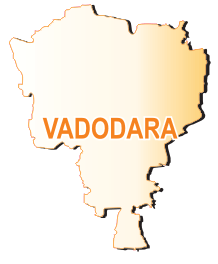 |
Vadodara is a graceful city of palaces, parks, temples and museums and is situated on the south of city of Ahmedabad. It is also known as Baroda. Vadodara is the industrial and cultural capital of the State of Gujarat. Vadodara has a rich historical background. It was an important native state in Western India. The ardent historian can trace Vadodara's history over 2000 years and more. Vadodara, the capital city of Gaekwar State, is situated on the banks of Vishwamitri, a river whose name derived from the great saint Rishi Vishvamitra. The city was once called Chandanavati after its ruler Raja Chandan of Dor tribe of Rajputs, who wrested it from the Jains. The capital had also another name "Virakshetra" or "Virawati" (a land of warriors). Later on it was known as Vadpatraka or Wadodará, which according to tradition is a corrupt form of the Sanskrit word Vatodar means 'in the heart of the banyan tree'. It is now almost impossible to ascertain when the various changes in the name were made; but early English travellers and merchants mention the town as Brodera, and it is from this that the name Baroda is derived. Again in 1974 the name changed to Vadodara. |
Vadodara
at a Glance |
|||||||||||||||||||||||||||||||||||||||||||||||||||||||||||||||||||||||||||||||||||||||||||||||||||||||||||||||||||||||||||||||||||||||||||||||||||||||||||||||||||||||||
Vadodara Weather
|
Summer : Max 45°C, Min 24 °C | ||||||||||||||||||||||||||||||||||||||||||||||||||||||||||||||||||||||||||||||||||||||||||||||||||||||||||||||||||||||||||||||||||||||||||||||||||||||||||||||||||||||||
| Winter : Max 31 °C,
Min 11°C Winters are cool and pleasant. Best period to visit Vadodara is between October and February. |
|||||||||||||||||||||||||||||||||||||||||||||||||||||||||||||||||||||||||||||||||||||||||||||||||||||||||||||||||||||||||||||||||||||||||||||||||||||||||||||||||||||||||
How to Reach to Vadodara
|
By
Air: Vadodara is connected by various domestic airlines
(Air India-Indian, Jet Airways & Indigo) to Delhi, Mumbai,
Chennai and Bangalore. The nearest international airport is located
in Ahmedabad, which is located 100 km away from the city. Ahmedabad
is also connected with many other cities by domestic airlines. |
||||||||||||||||||||||||||||||||||||||||||||||||||||||||||||||||||||||||||||||||||||||||||||||||||||||||||||||||||||||||||||||||||||||||||||||||||||||||||||||||||||||||
By
Train: Vadodara is major railway junction on the Western
Railway. Vadodara railway station is located on the northwestern
part of the city, near the local bus station. As Vadodara is on
the main Ahmedabad–Mumbai line a number of trains pass and
stop at Vadodara. Direct trains are available from Ahmedabad,
Mumbai, Pune,
Kolhapur, Madgaon, Indore, Bhopal, Jabalpur, Delhi, Ferozpur,
Dehradun, Amritsar, Chandigarh, Jammu Tawi, Kalka, Varanasi, Gorakhpur,
Muzaffarpur, Jaipur, Ajmer, Jodhpur, Bikaner, Lucknow, Chennai,
Bangalore, Mysore, Coimbatore, Kakinada, Nagercoil, Kochuveli,
Yesvantpur, Ernakulam, Trivandrum, Rameshwaram, Howrah, Guwahati,
Puri etc. |
|||||||||||||||||||||||||||||||||||||||||||||||||||||||||||||||||||||||||||||||||||||||||||||||||||||||||||||||||||||||||||||||||||||||||||||||||||||||||||||||||||||||||
By
Road: State transport buses and private luxury coaches
connect Vadodara to various towns and cities of Gujarat, Maharashtra,
Madhya Pradesh and Rajasthan. |
|||||||||||||||||||||||||||||||||||||||||||||||||||||||||||||||||||||||||||||||||||||||||||||||||||||||||||||||||||||||||||||||||||||||||||||||||||||||||||||||||||||||||
Distance
of Major Cities from Vadodara |
|||||||||||||||||||||||||||||||||||||||||||||||||||||||||||||||||||||||||||||||||||||||||||||||||||||||||||||||||||||||||||||||||||||||||||||||||||||||||||||||||||||||||
|
|||||||||||||||||||||||||||||||||||||||||||||||||||||||||||||||||||||||||||||||||||||||||||||||||||||||||||||||||||||||||||||||||||||||||||||||||||||||||||||||||||||||||
Places
to Visit in Vadodara |
|||
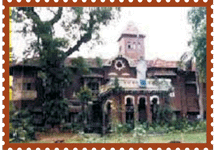
Aurobindo
Society |
 |
||
 |
Sayaji
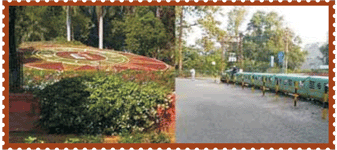
Garden Spread in the area of 113 acres of land the garden is the oldest and the largest one among all the 50 parks and gardens of the city. This nicely manicured lush green garden was a gift by the great ruler Maharaja Sayajirao to his subjects. The garden includes Baroda Musesum and picture Gallery, the Zoo, Sardar Patel Planetarium, Floral Clock, Health Museum, Picnic Corners, Band Stand, Toy Train and a few Joy Rides. The Toy Train is extremely popular amongst children. It runs on a small track width 10 inches covering a distance of 3.5 Km. giving the entire view of the garden to the children |
||
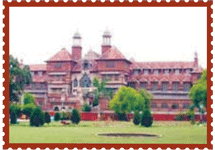
Vadodara Museum and Art Gallery Located
in the popular Sayaji Bagh, the museum houses a collection which
belonged to the former Maharaja Sayaji Rao Gaekwad. Indian rulers
during the Raj often collected all kinds of European art and
other knick knacks. Founded by the Gaekwads in 1894 A.D., the
museum has an impressive collection on Art and Archaeology,
Natural History, Geology and Ethnology. The adjoining art gallery
has a great collection of old European Masters: Veronese, Giordano,
Zurbaran, some Flemish and Dutch School paintings, Turner and
Constable, a collection of Mughal miniatures and valuable palm-leaf
manuscripts of Buddhist and Jain origin. The Egyptian mummy
and skeleton of a blue whale are major attractions for those
who visit the museum.Other treasure includes the famous Akota
bronzes dating the 5th Century A.D. |
 |
||
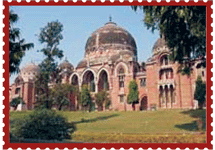 |
M.S.
University of Baroda |
||
Kirti
Mandir
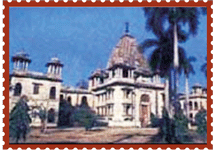
Kirti Mandir meaning 'Hall of Fame', is a memorial for the Gaekwad rulers, situated on the north of the statue of Prince Fatehsinhrao Gaekwad near the Vishwamitri Bridge in Vadodara. It is a monument built by Maharaja Sayaji Rao III in 1936 in the memory of his ancestors, along with a cluster of Shiva temples. Various
rooms of this E-shaped large magnificent stone building are decorated
with photographs of the members of the royal family. The building
has a marble-finished interior. Walls of its central hall have
the murals of Gangavataran, battle of Mahabharat, life of Meera
and Natir Puja. There is a huge dome, terraces, statues and photographs
of the Royal family in this temple. |
 |
||
 |
EME
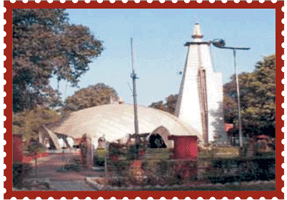
Temple The Indian army does not usually have separate places of worship for the different faiths, but this EME temple (also known as Dakshinamurthy Temple), built by the Electrical and Mechanical Engineering (EME) corps entirely out of aluminum sheets, worships Dakshinamurti, another name for Shiva as an ultimate teacher. This uncommonly modern-looking temple is, however, built with holy symbols from various religions. EME temple`s inimitable concept and design and geodesic structure lends it a strange aura. It is built solely out of aluminum alloy and steel. The temple complex boasts brilliant idols obtained from the excavations undertaken in nearby areas, some of them dating back to the 6th century. These idols are placed on both sides of the entrance walkway, which brighten up at night in illumination. The architectural pattern represents five religions- the `kalash` on the top of the dome signifies Hinduism, the `dome` signifies Islam, the `tower` represents Christianity, the `golden-structure` on the top of the tower represents Buddhism and the entrances to the temple with their respective shapes signifies Jainism. In this respect, it is regarded as the only structure of its kind in India. It is open from 6:30am-8:30pm. Photography is prohibited. |
||
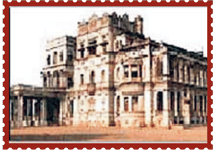
Nazarbaug
Palace It
displays royal heirlooms and works of old masters such as Raphael,
Titian and Murillo. Indian Paintings, Graeco-Roman exhibits and
Chinese and Japanese art are included in the collections. |
 |
||
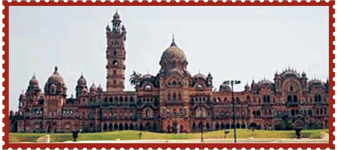 |
Lakshmi
Vilas Palace
The
Royal Family's residence is an extravagant building in Indo- Saracenic
style. The palace built by Maharaja Sayajirao in 1890 is till
date the residence of the royal family. Its ornate Darbar Hall
has an Italian mosaic floor and walls with mosaic decorations.
The palace houses a remarkable collection of old armoury and sculptures
in bronze, marble & terracotta. |
||
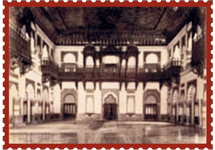
Darbar Hall (Lakshmi Vilas Palace) Darbar Hall of Lakshi Vilas Palace is sometimes the venue of music concerts and other cultural events, has a Venetian mosaic floor, Belgium stained glass windows and walls with intricate mosaic decorations. Outside of the Darbar Hall is an Italinate courtyard of water fountains. The palace houses a remarkable collection of old armoury and sculptures in bronze, marble & terracotta by Fellici. The grounds were landscaped by William Goldring, a specialist from Kew Gardens. |
 |
||
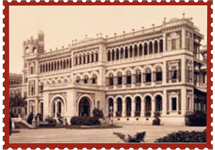 |
Makarpura
Palace This lovely place was build by Maharaja Khanderao (1856-1870 AD) for his residence. There was a magnificent Deer Park adjoining the place. Sayaji Rao III added a new wing to it and renovated the palace, which was in ruins. This new wing was designed in the contemporary European style. An excellent garden and a summerhouse surround the palace. |
||
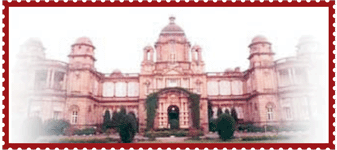
| Pratap Vilas Palace (The Railway Staff College) Designed in renaissance architecture, it houses the Railways Staff College, the main training center of the Indian Railways. The college is equipped with a beautiful mini railway model room showing different types of railway operations including track signals. The Railway Staff College is the Alma Mater for the officers of the Indian Railways. It is situated in a sprawling campus of 55 acres of the Pratap Vilas Palace at Lalbaug, Vadodara. It provides training to all levels of IR officers, from probationers to General Managers |
 |
||
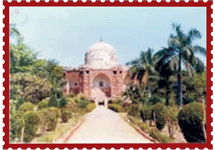 |
Maqbara
(Hajira) |
||
Nyay
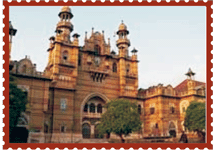
Mandir This Temple of justice is a magnificent and massive building built in Mixed Indo- Sarcenic and European style by Maharaja Sayaji Rao III. It is two storied with large courts and a fine central hall decorated with mosaic works. A beautiful marble statue of Chimnbhai, the first queen of Sayaji Rao III adorns the hall. The building is used at present as District court. |
 |
||
 |
Sursagar
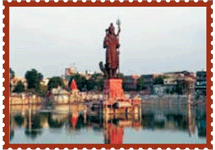
Lake Earlier the Sursagar Lake was known as Chandan Talao. The lake was rebuilt with stone banks and masonry in 18th century. It has a marvelous view particularly on moonlit nights. There is a Statue of Shiva in the middle of Sur Sagar Lake. |
||
Other
Places to visit are Iskcon Temple, Navgrah Temple, Kirti Stambh,
Khanderao Market (Vadodara Municipal Corporation Building), Lehripura
Gate, Mandvi Gate, Lal Baug, Jubilee Garden, Mahatma Gandhinagar
Gruh (Town Hall), Suryanarayan Temple, Tambekar Wada, Kashi Vishwanath
Temple, Vivekananda Kendra, Swaminarayan Temple, Ataladara etc.
|
|||
Vadodara
City Map with Tourist Spots |
|||
View Vadodara City in a larger map |
|||
Vadodara Surroundings |
|||
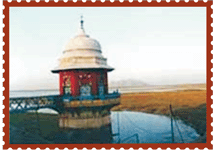
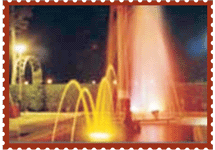
Sayaji
Sarovar or Ajwa Lake, Ajwa Garden & Nimeta
Garden The Municipal Corporation
has prepared a beautiful garden which resembles with the famous
Vrundavan Garden of Mysore. Illuminated and musical fountains
are operated on every Saturday, Sunday and Monday, which is
a major attraction. The entire garden turns into a fairyland
in the evening when the fountains are illuminated. |
 |
||
 |
|||
 |
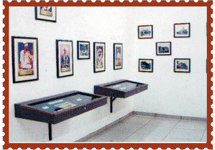 |
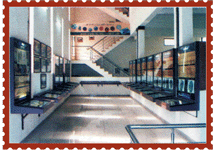
Shree Mudra
Nidhi Coin Museum, Ajwa |
|
Goraj
- Muni Seva Ashram |
|
||
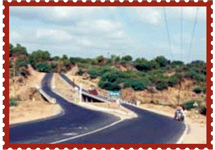 |
Sindhrot
- Nature Park |
||
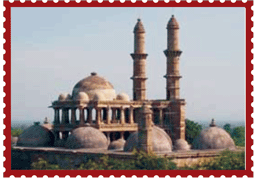
Champaner
Pavagadh Archaeological Park |
|
||
 |
|||
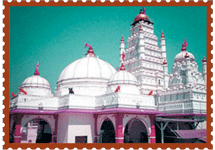 |
Dakor 50
kms. from Vadodra is famous for its Temple of Ranchodrai and is
a sacred place for the followers of Lord Krishna. His image, said
to be the original from Dwarka, was brought here by a devotee
and installed in the temple.Several thousands of devotees visit
holy temple every month on Poornima. Dakor is easily accessible
by road. |
||
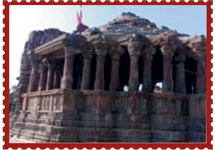
Galteshwar A
place situated on the riverbank of the Mahi is used mainly as
a picnic spot. It is about 16 km from Dakor and 80 km from Vadodara.
. The Galteshwar Temple, dedicated to Lord Shiva, is a prominent
attraction. Thousands of pilgrims visit this emple to offer
prayers. Dakor Railway Station is the nearest railhead. |
 |
||
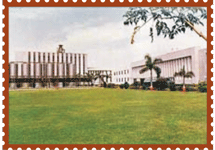 |
Anand |
||
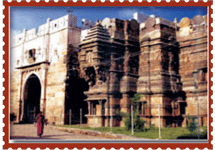
Dabhoi Dabhoi is 29 Kms.
South East of Vadodara. It was established in the early 6th
century AD. Its foundation and fortification is ascribed to
King Siddhraj Jaisinh (1093-1143 AD), who made this his frontier
fortress. The fort of Dabhoi (originally called Darbhavati)
is one of the rare surviving examples of Hindu military architecture,
based on the shastri traditions described in various Vaastu
scriptures. The famed battle of Dabhoi was fought on April 1,
1731 between Sarsenapati Trimbakrao Dabhade and Bajirao Peshwa.
Hira Bhagol gate is known for its unique carved gate. |
 |
||
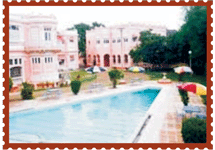 |
Rajpipla Harsiddhi Mataji Temple The idol of Harsiddhi Mataji with a sindoor face was brought on foot by Maharana Verisalji (I) to Rajpipla from Ujjain (a holy place, now in Madhya Pradesh) in 1657. It is believed that the Ruler had a dream whereby while carrying the idol if he looks back at whichever place then it is to be installed there itself. So presently the temple is built at the same place and the Goddess is the deity of the Rajpipla Royal Family, Although devotees come throughout the year, but especially during Navaratri Festival, thousands of worshippers visit the Temple for prayers where an amusement fair is also held. |
||
 |
|||
 |
|||
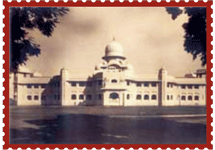
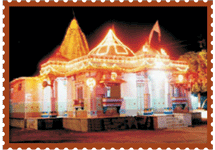
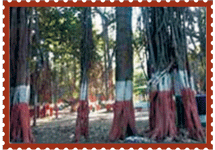
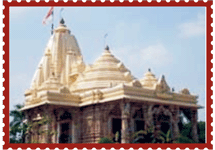
Kabirwad This famous place is on an island in the middle of Narmada River, and regular mechanized boats operate to and fro from the banks near the pilgrim town of Shuklatirth to Kabirwad. It is known for its gigantic Banyan Tree which covers a vast area and is believed to have grown when Saint Kabir lived here during the last many years, the roots of this enormous tree has spread to larger circumference, making it extremely shady where many varieties of birds have taken shelter. Now since many years there is an imposing Kabir Temple where worshippers come and is popular on weekends and holidays, when families, students and other groups visit for picnic and outing. There is also a shorter one and a half hour route to reach Kabirwad from Rajpipla by going in a boat on banks of River Narmada between Rajpardi and Jhagadia. |
 |
||
 |
Kayavarohan
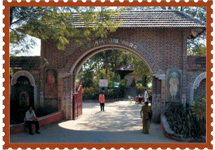
Kayavarohan, popularly known as Karvan, it is situated on National Highway No. 8, 30 kms from Baroda. It is an ancient town believed to have existed through each of the Four Ages according to the Hindus. According to a popularly held belief it was from here that Lord Shiva in the guise of a child transmigrated after death and his body disappeared. Thus the place came to be known as Kayavarohan. A number of copper coins and a stone quern have been found from here. A beautiful head of Tapas, the image of Kartikeya and an idol of Uma Maheshwara are some of the archaeological specimen discovered from here. |
||
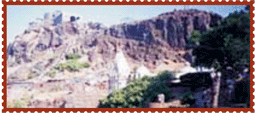
NARESHWAR (60 kms) situated on the banks of river Narmada and also famous for the ashram of Shri Rang Avdhoot.
SANKHEDA (60 kms) at east of Vadodara known for its laquer painted colourful wooden furniture and handicrafts heritage.
CHANDOD (60 kms) religious place on the banks Narmada River at east of Vadodara.
KARNALI known as the "Benares of the South" situated on the banks of River Narmada has all the trappings to make for an ideal place of pilgrimage and meditation. It is very near to Chandod.
SOKHADA (10 kms) : Shri Akshar Purushottam Swaminarayan Mandir Haridham, Sokhada.
Ahmedabad was founded by Sultan Ahmad Shah in 1411 AD, and has grown into one of the most important modern cities of India. Ahmedabad, the largest city of Gujarat and sixth largest city of India is situated at the bank of Sabarmati River. Formerly Ahmedabad was known as Manchester of India for its textile industries. Ahmedabad is also called Karnavati and Amdavad.
 The
Ahmedabad-Vadodara Express Highway is a major artery of public transport
connecting the cities of Ahmedabad and Vadodara. The 95 km long expressway
which is a part of the Golden Quadrilateral Project by NHAI, reduces
the travel time between the two cities from about 2.5 hours on National
Highway 8 (NH 8) to about an hour now. There are two exits provided
for Nadiad (50 km from Vadodara) and Anand (35 km from Vadodara).
The
Ahmedabad-Vadodara Express Highway is a major artery of public transport
connecting the cities of Ahmedabad and Vadodara. The 95 km long expressway
which is a part of the Golden Quadrilateral Project by NHAI, reduces
the travel time between the two cities from about 2.5 hours on National
Highway 8 (NH 8) to about an hour now. There are two exits provided
for Nadiad (50 km from Vadodara) and Anand (35 km from Vadodara).
The mosques and mausoleums in the once walled city blend Muslim and Hindu styles of architecture. The Sidi Bashir mosque, with its 'Jhulta minars' (shaking minarets) continues to amaze and puzzle casual visitors and serious scholars alike. There are several stunning Hindu and Jain temples in and around Ahmedabad. The step wells with their intricate carved stone pillars are exquisite. At the 55-year old Calico Museum of Textiles, one of the best textile museums in the world, one can see and marvel at samples of the finest fabrics and weaving machines produced in different parts of India since early 16th century. Mahatma Gandhi's non-violent satyagraha, which led to India's Independence, was launched from this city. Gandhi's Ashram, Hriday Kunj, is still preserved on the bank of the Sabarmati, and continues to attract and inspire visitors from all parts of the globe.
One can go on day-excursions from here to Akshardham (Swaminarayan Temple, Gandhinagar, 25 km), the sun temple (Modhera, 106 km), Nalsarovar (bird sanctuary that attracts tens of thousands of migratory birds from cold countries, 70 km), and Lothal (remnant of a 4500-year old city, 80 km). Within easy reach is the Gir National Park, the only place in Asia you can encounter the Asiatic lion in its natural habitat (400 km). The Little Rann of Kutchh sanctuary (100 km) protects the only surviving population of Wild Ass (the Equus Hominus Khur Species) in the world. Surat, the heart of the diamond industry in India, is just five hours away by road or rail (250 km).
View Vadodara Surroundings in a larger map
